
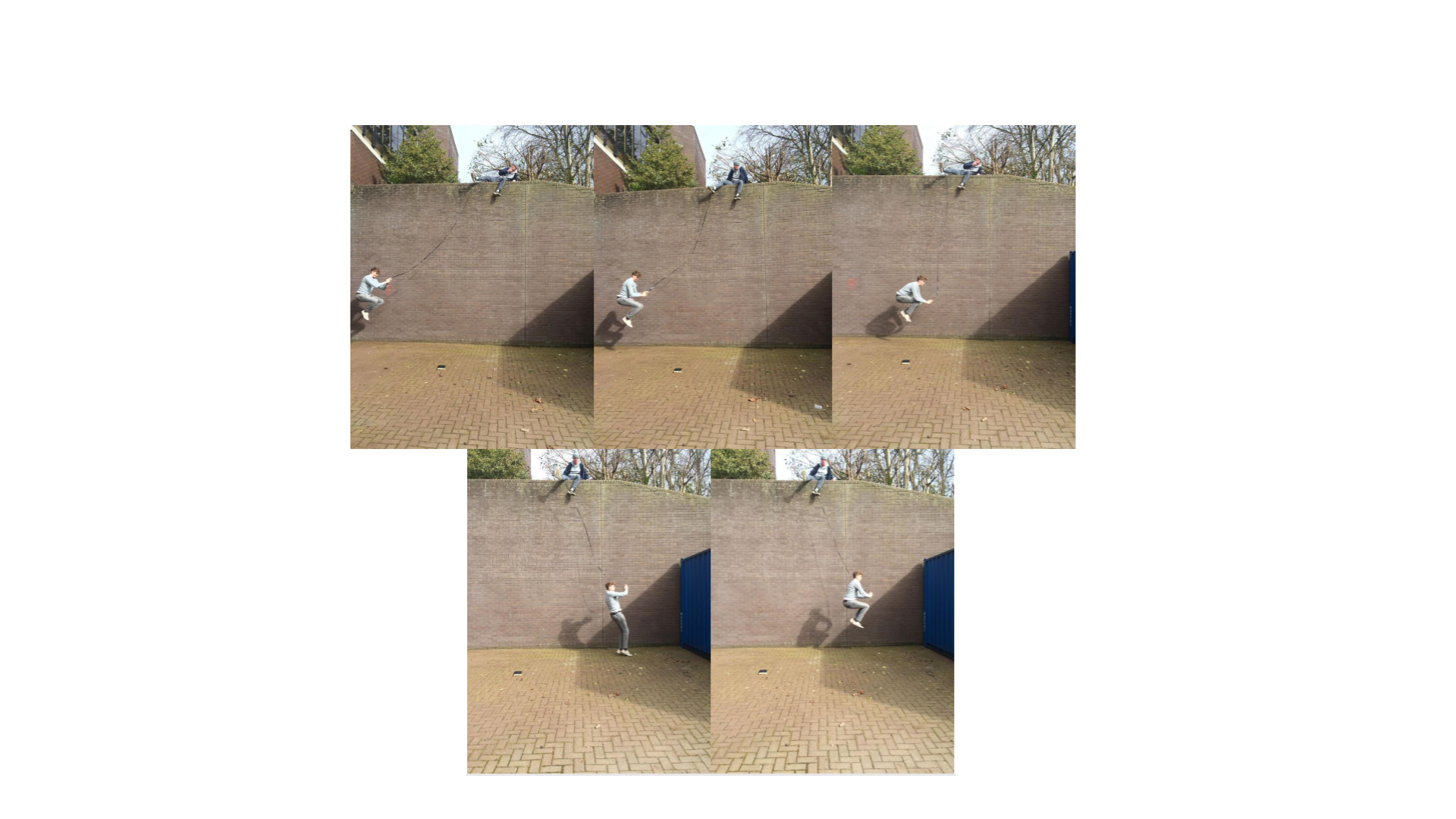
We recently had the opportunity to collaborate with vis. comm. students from LSAD to produce images which incorporated the use of perspective in order to achieve an optical illusion — a Trompe l’oeil, as the brief was called.
It’s interesting how something which is seemingly insignificant from one angle can become an extraordinary image when viewed from the correct perspective.
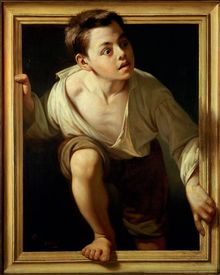
Artists often use this visual trickery to make their compositions more appealing — it creates the illusion of depth on a two dimensional plane. The subject almost leaps from the conceptual world into our reality. A great example of this being executed well is ‘Escaping Criticism’ by Pere Borrell del Caso in 1874. The character climbs out from the frame, confronting the audience as he escapes from the composition into the gallery space.
Another master of this technique is the world renowned street artist and provocateur Banksy. He is well known for his use of simple black and white stencilling to give commentary on a huge range of issues, and cleverly incorporates tricks of the eye into his work.
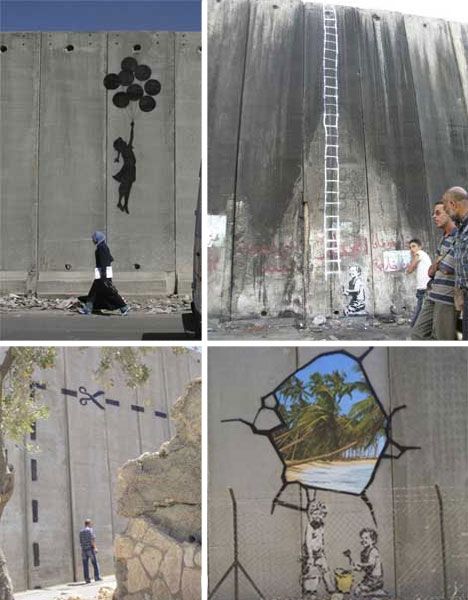
Possibly some of his most controversial pieces of recent times have been done on the wall which separates Israel and the occupied Palestinian territories in Bethlehem.
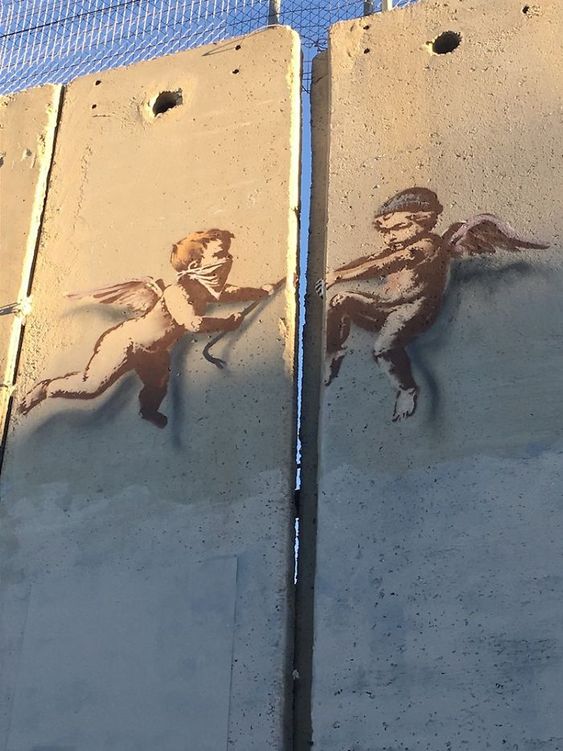
He uses features in the wall, such as cracks and discolourations, to comment on the situation which is currently on going in this area. The wall, a symbol of the oppression of one people by another, has become a huge canvas for artists such as Banksy to ridicule the injustices committed by the Israeli regime.
Something that has been a symbol of oppression has become adorned in images of resistance, executed in such a way that the subjects seem to be dismantling and conquering it.
Pieces of art such as these can have much more of an impact than some painting hanging in a gallery — they occupy and, more importantly, incorporate a public space to turn it from something mundane into something moving. Something which forces you to stop and wonder how the artist saw useful elements for a piece of work in something as ordinary as a crack in a wall.
Needless to say, the optical illusions we created were nowhere near as captivating as those produced by the likes of Banksy and other artists who incorporate these techniques. Maybe it was the time constraint, maybe we didn’t have the materials to execute what we wanted to do — however, the exercise opened us up to another way of thinking and of seeing the world around us. Public spaces such as our campus needn’t be arid areas with pristine walls and sterile spaces; each wall has the potential to be a canvas, every window pane a surface to add to the view outside. Something as simple as a roll of tape or some chalk can bring life to a space that would otherwise be of little interest to passers by — even if we did look a little crazy during the process of creating the artwork.
It’s not always about pasting an image you’ve created into a space; sometimes, it’s simply about seeing the image in the space and extracting it out from the walls so that those who pass by absent minded can appreciate it too.
Next post