
Assistive Tech / Wearable · 2019
Co-Pi — Cognitive Aid
A wearable and carer app that helps young adults with Down Syndrome navigate time, daily tasks and independence — designed from cognitive strengths, not deficits.
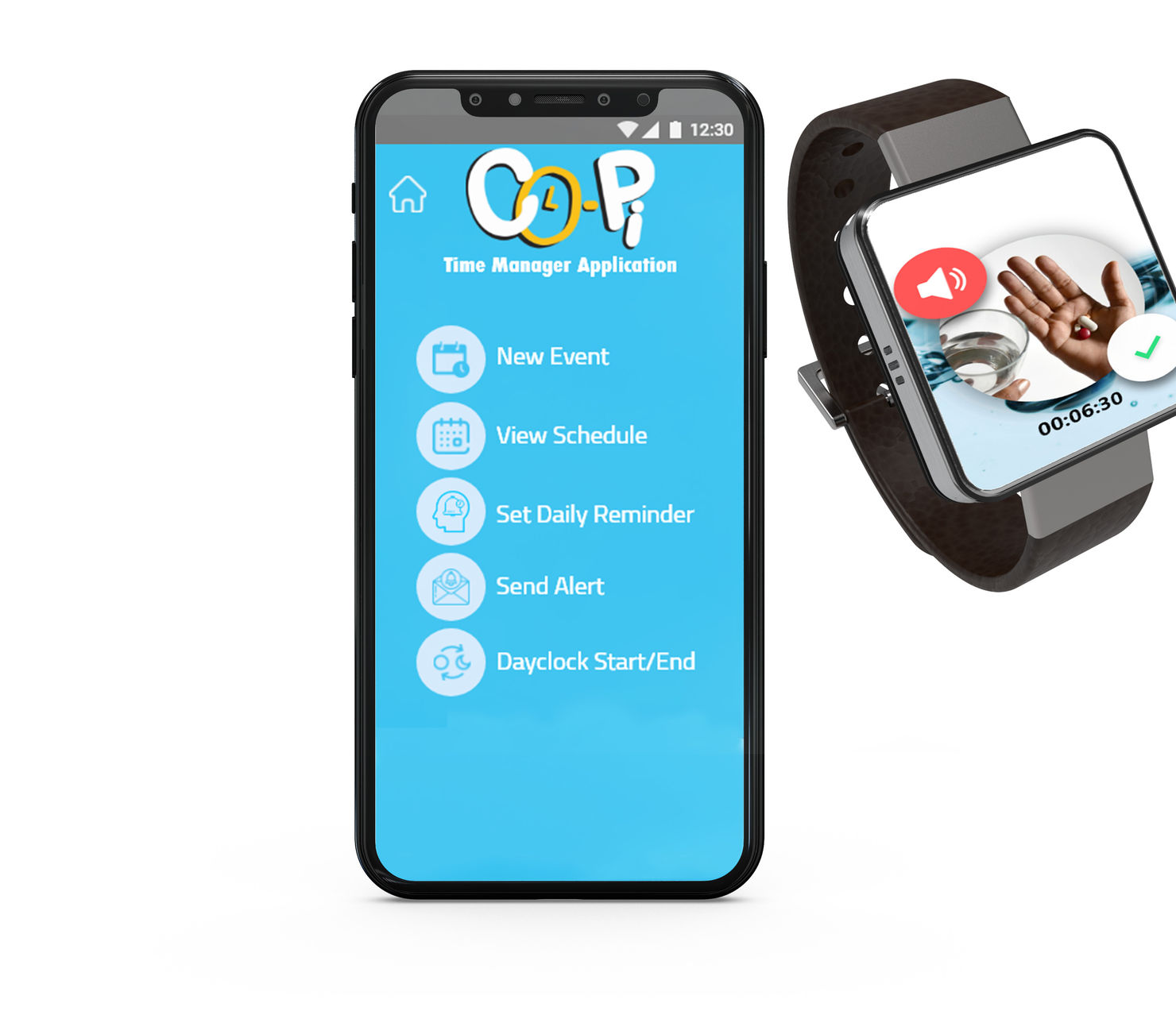
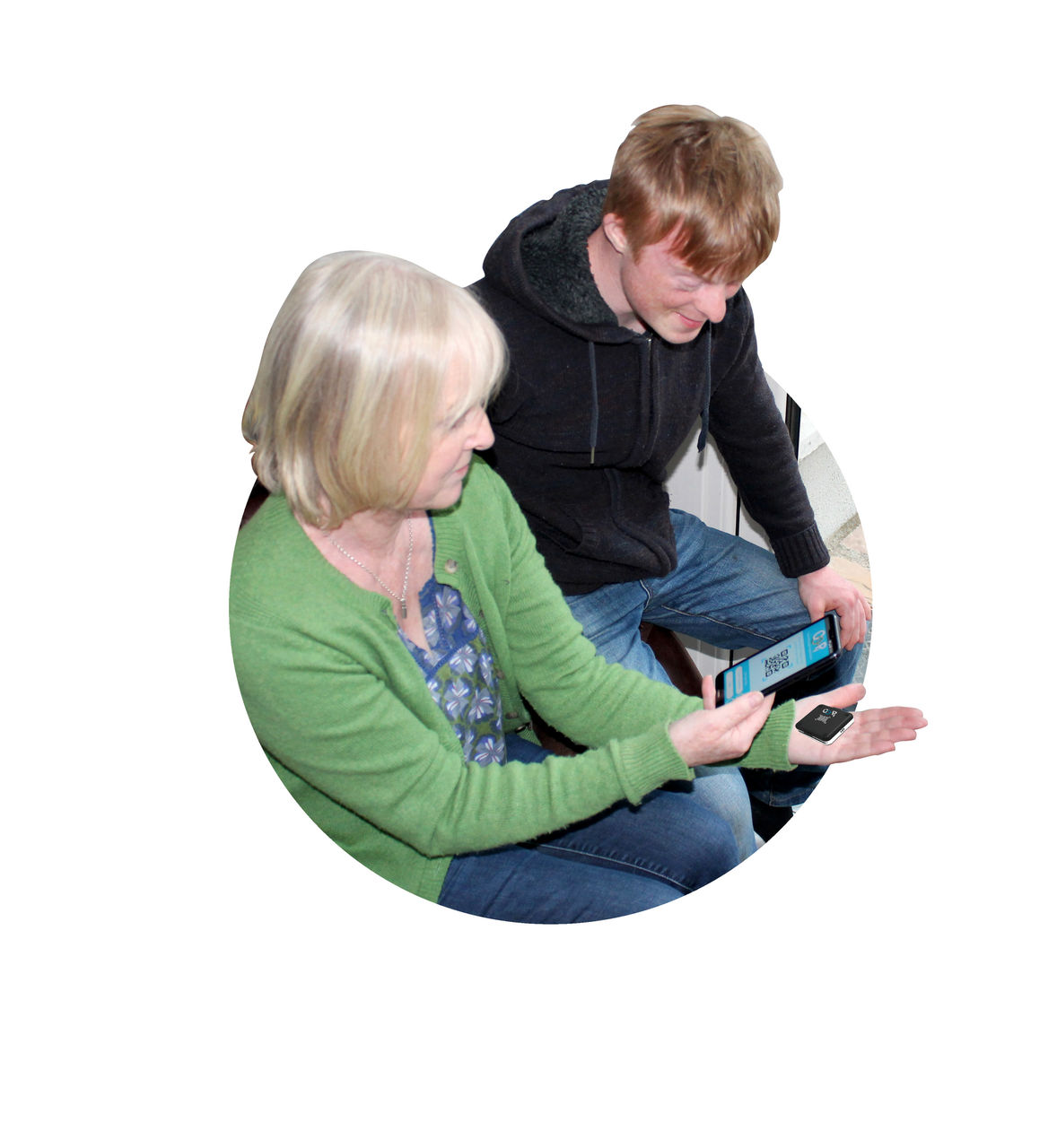
Co-Pi is a modular smartwatch, charging dock and Guardian carer app, designed around the cognitive profile of young adults with Down Syndrome and the parents and carers who support them.
- Role
- End-to-end research, concept, industrial design, UI, prototyping
- Duration
- 9 months — Final Year Design Project, 2019/20
- Tools
- Field research, Focus groups, Survey, CAD, UI prototyping, KeyShot
The problem
People with Down Syndrome often have a difficult time acquiring basic numeracy skills — typically they are two years behind their literacy skills.
This affects their ability to live independently, as they have problems remembering the order of tasks and with basic real-life maths and time tasks: shop transactions, reading a clock, train times.
In adult life, this means they are at even more of a disadvantage entering the world of work or in performing daily tasks.
Cognitive profile — areas of relative difficulty
Having Down Syndrome affects an individual's early and continued development in three major ways. With help and practice they can become competent in many areas of their lives — but the design has to account for these.
Sensory-motor cognition — problems learning to crawl and walk in infancy, and difficulties developing motor skills in early childhood compounded by low muscle tone.
Short-term memory — problems retaining information such as ordered tasks. This deficiency makes learning all things slower and more difficult.
Language (learning, comprehension and expression) — problems learning words as children as well as speaking. Comprehension is usually noticeably better than production.
Sensory-motor cognition
Difficulties developing motor skills in early childhood, compounded by low muscle tone.
Short-term memory
Difficulty retaining information such as ordered tasks — slowing the learning of all things.
Language
Difficulty learning words and speaking. Comprehension is usually noticeably better than production.
Cognitive profile — areas of relative strength
People with Down Syndrome are often highly social and love to participate in class and community activities. They are also, for the most part, visual and tactile learners. Catering to these strengths is the best way to accelerate personal development.
Strong interest in face-to-face social interaction — enabling individuals to socialise is the best way to develop verbal communication and language.
Visual memory — people with DS are visual learners and think in images. Visual learning aids are highly effective, especially over rote methods.
Gestural communication and language comprehension — many learn 'Lámh' to communicate as verbal communication is delayed. Speech comprehension often exceeds production.
Social interaction
Strong interest in face-to-face interaction — the best route to developing verbal communication and language.
Visual memory
Visual learners who think in images — visual aids are highly effective, especially over rote methods.
Gestural communication
Many learn 'Lámh' to communicate. Speech comprehension often exceeds production.
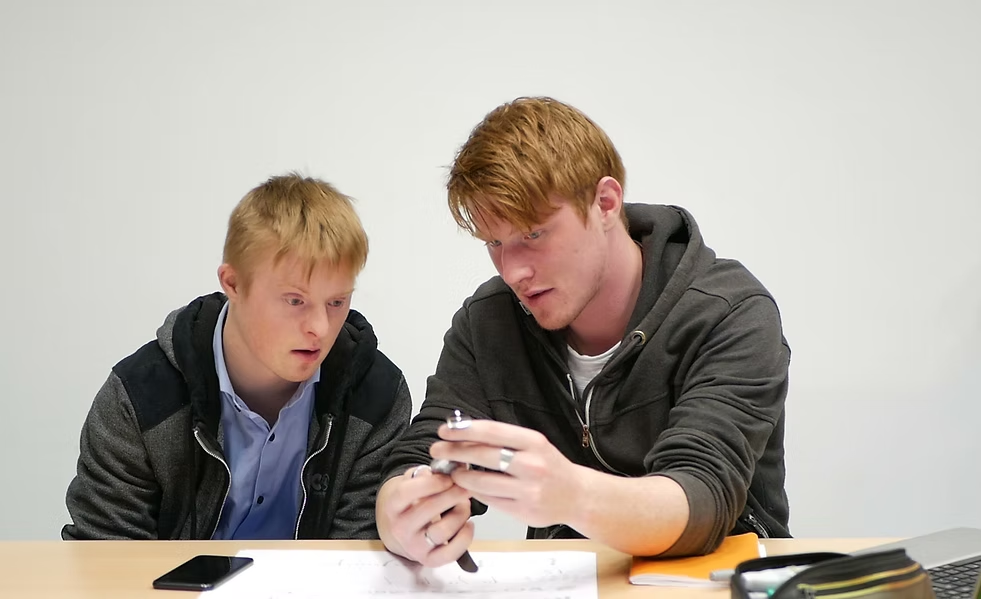
Focus group
Three teachers and SNAs from the LATCH course in Limerick — two were also parents of children with mental disabilities.
Observations
My brother's numeracy skills through tests, plus levels of ability across the LATCH class. Interviewed two students with DS.
Survey
Distributed to parents from the DSI National Committee meeting in Dublin — literacy, numeracy and independence.
Phone interviews
Parents of children with DS, Noirin Clancy (Inclusion Ireland), and Guillaume Jacquinot (EU Agency for Fundamental Rights).
Media
Videos provided by Inclusion Ireland alongside YouTube material on Down Syndrome.
Literature review
Papers on effective teaching practices, numeracy, quality of life, developmental profiles and social inclusion.
Research synthesis — three themes
Social inclusion — there is a strong push for social inclusion across the EU, but a lack of confidence in individuals' abilities, alongside carers and many parents performing tasks for them rather than helping them to do them, means they seldom get to participate in their communities fully. Many parents fear letting their child out alone in case they are taken advantage of or get lost. Developing the skills that make individuals work-ready and able to live more independently is a huge boost to confidence, self-image and mental health.
Externalising the mental load — people with DS are primarily visual learners and understand the world through symbols rather than words. Strong social skills help them overcome most obstacles, and their relationships with the people who care for them largely determine their independence and quality of life. Mental prosthesis — calculators, mobile phones, the internet, applications — has proven to be of extreme value because the mental load is externalised, enabling individuals to perform tasks that would otherwise be beyond their normal ability.
Life-skills development — developing an individual's life skills is a lifelong task for parents and carers; without frequent practice they often diminish. Learning must be related to concrete, personal aspects of the individual's life and broken into the smallest possible increments. Many young adults are competent in self-care and household tasks — it is in numeracy-related tasks (cooking, shopping, finances, time in context, navigation) where the difficulty lies. Reaching small milestones is a huge boost to self-image and a source of pride for caregivers.
Social inclusion
Confidence to participate fully in community life — work-ready skills as a boost to self-image and mental health.
Externalising the mental load
Mental prosthesis — phones, apps, visual symbols — unlocking tasks otherwise beyond reach.
Life-skills development
Concrete, personal, broken into small increments. Small milestones, big pride.
Ideation
I explored four directions before converging on the wearable system: handling shop transactions, navigation and orientation, daily planning, and a timeline view of the day.
From observation to design driver
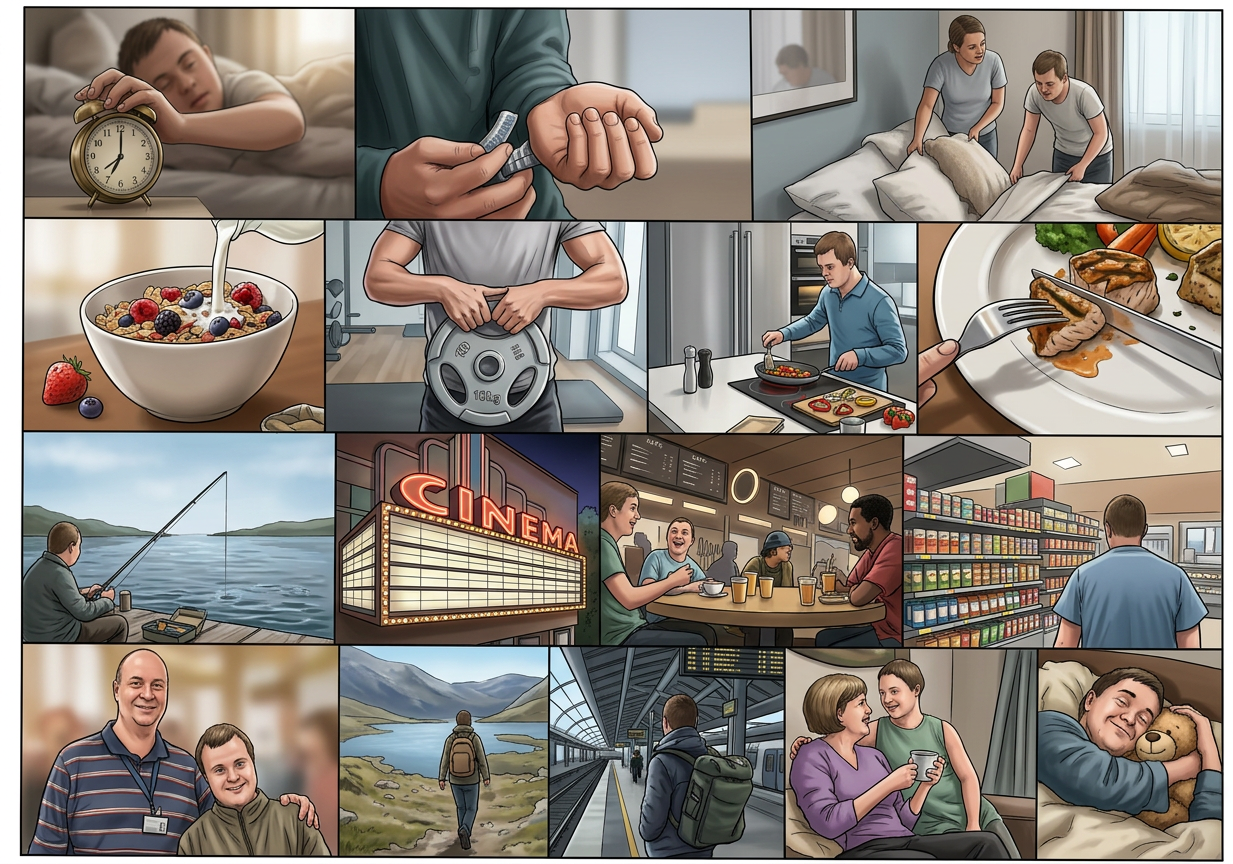
I began by examining my brother's daily routine, keeping a diary of the tasks he did himself each day alongside the different places and venues he visited. I then split these tasks into those that were dependent on time and those that were not.
Following this I gauged his present level of understanding of time alongside that of his peers.
I discovered that the problem does not lie so much in being able to read the numbers on a clock-face but rather in understanding what those numbers mean in the context of the day — should I get up, make dinner, go out — as well as understanding how long certain events take. One example: he waited around for over an hour for a taxi because he did not know how much time had passed.
These insights became the key areas of focus in the development of my designs.
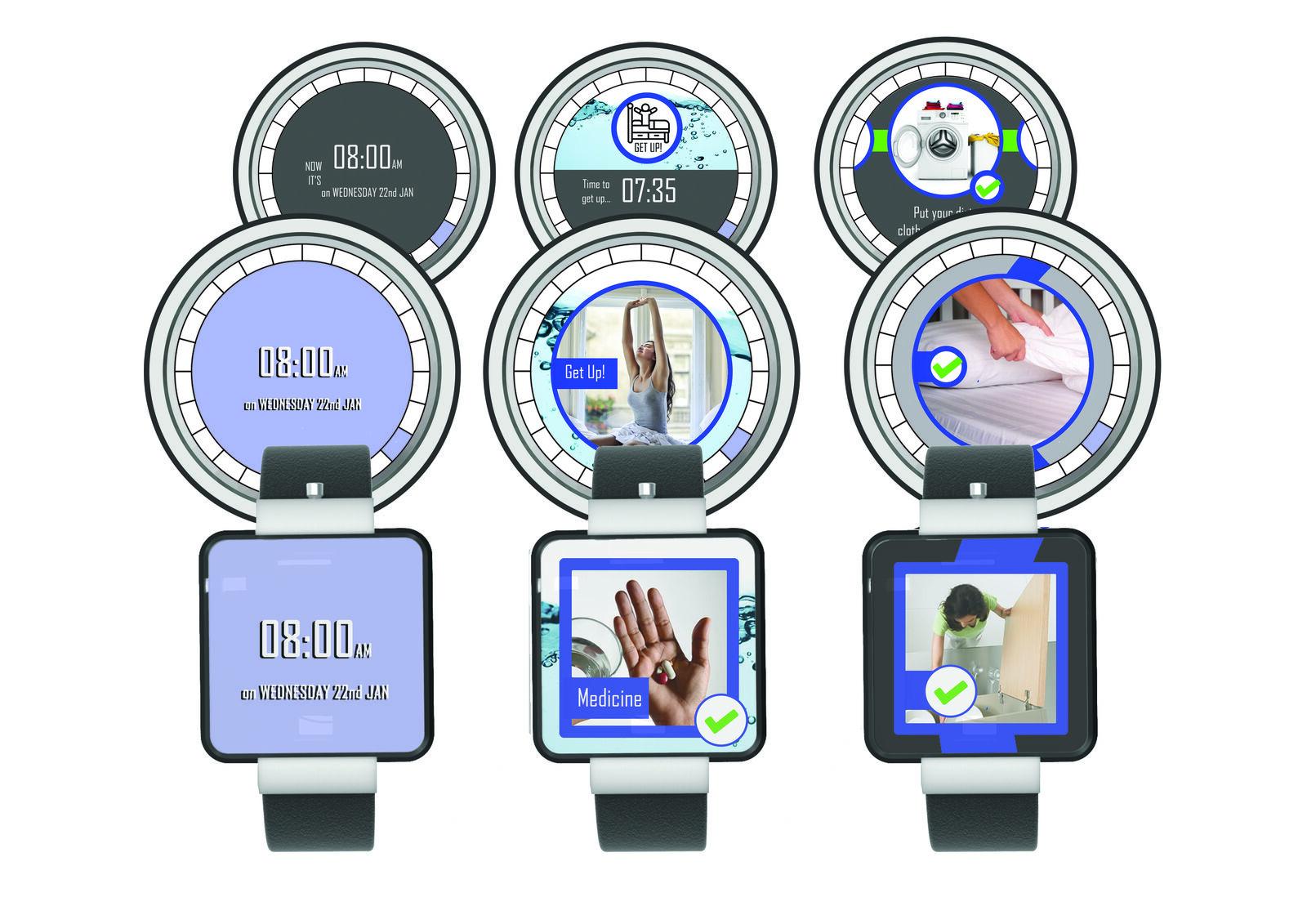
The system
Dayclock — since young adults with DS often struggle to understand the time in the context of the day, but can usually read the numbers fine, the Dayclock matches the time with the colours you would see in the sky at that point. This helps orient the wearer to where they are in their day.
Visual Timer — since the numbers on a timer mean little to someone who cannot interpret them, this is a non-numeric workaround. Similar products have used fractions to solve the same problem and failed with this user group, as that level of mathematical understanding is often beyond their ability.
Non-time-dependent daily tasks — because of deficits in short-term memory it can be extremely difficult to remember the day's tasks without a parent or guardian there to remind. Being able to see what needs to be done, and to do it on their own, greatly boosts self-image.
Time-dependent tasks — paired with the Dayclock so prompts arrive when the day has actually reached that point.
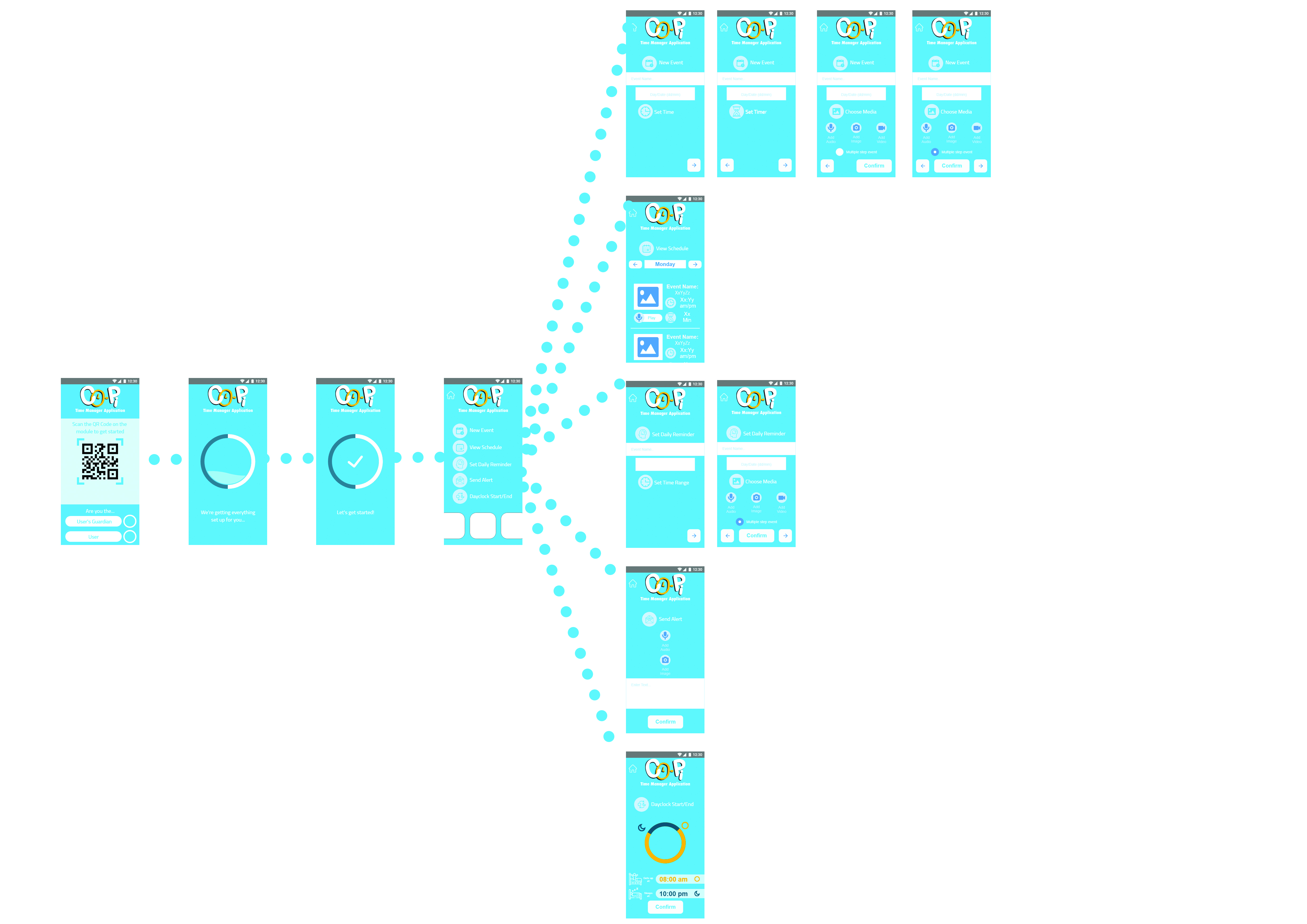
Guardian app — for parents and carers to programme the day, add events, and get reassurance that prompts have been seen and acted on.
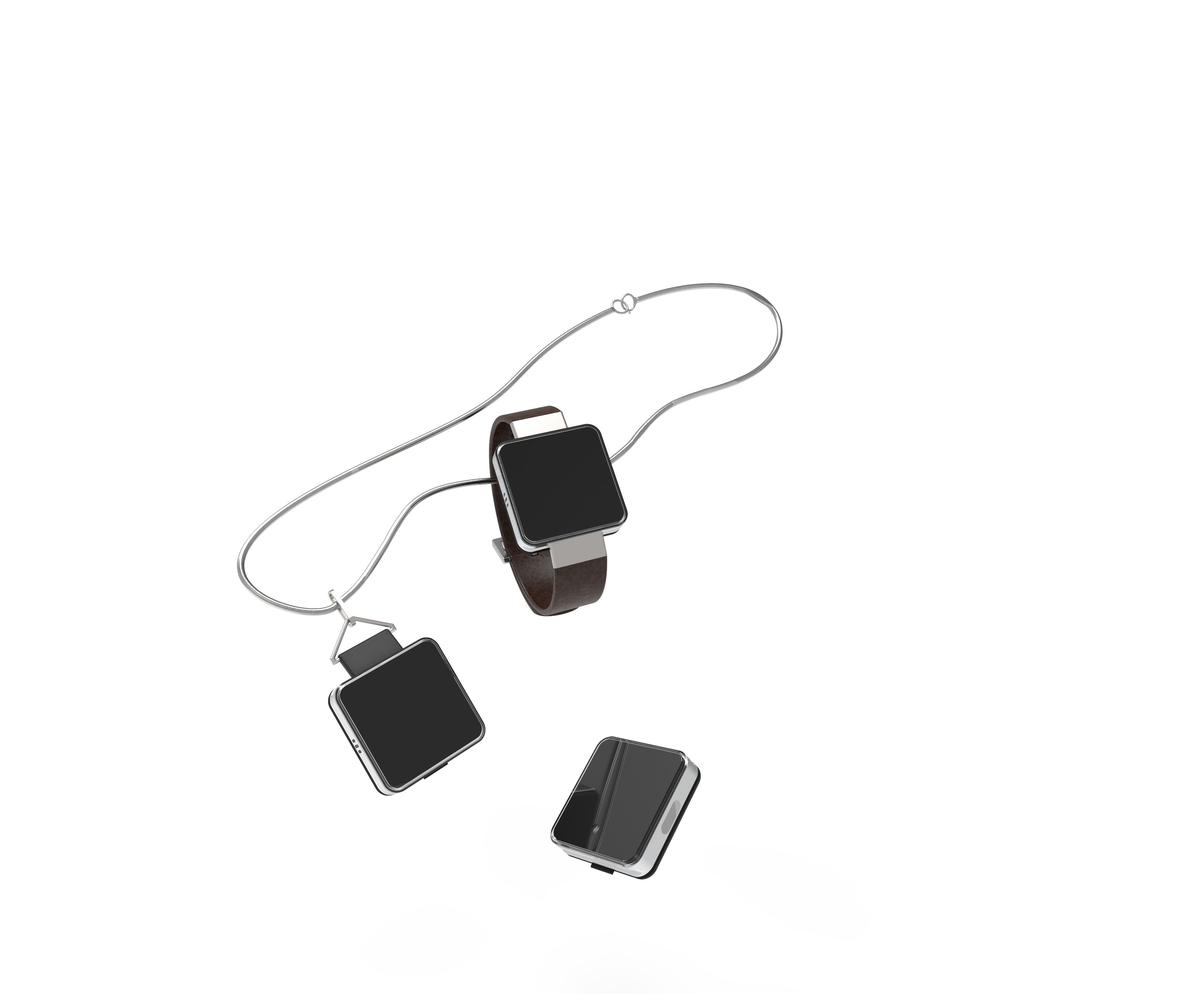
Hardware — a watch module that detaches from its strap into a charging dock, designed to work for hands that struggle with fiddly clasps.
Reflection
Co-Pi is a final-year concept project, not a shipped product, and I'm careful not to claim more for it than that. What it gave me is a way of designing for cognitive difference that starts from strengths — visual memory, social interaction, gestural communication — rather than from a list of deficits.
It also produced a system pattern I'd carry forward: a wearable that pushes prompts to the moment a task actually needs to happen, paired with a carer-side app that supports without taking over. Independence isn't a feature you add; it's what's left when you stop substituting for the person.
“Reaching small milestones is a huge boost to self-image and a source of pride for caregivers.”
— Research synthesis