
Industrial Design — Materials & Concept · 2019
Dolmen Real-World Studio — Next-Generation Shower Tray
Six-week material-led concept project for the next generation of shower trays — exploring high- and low-volume production with a focus on circularity and accessibility.
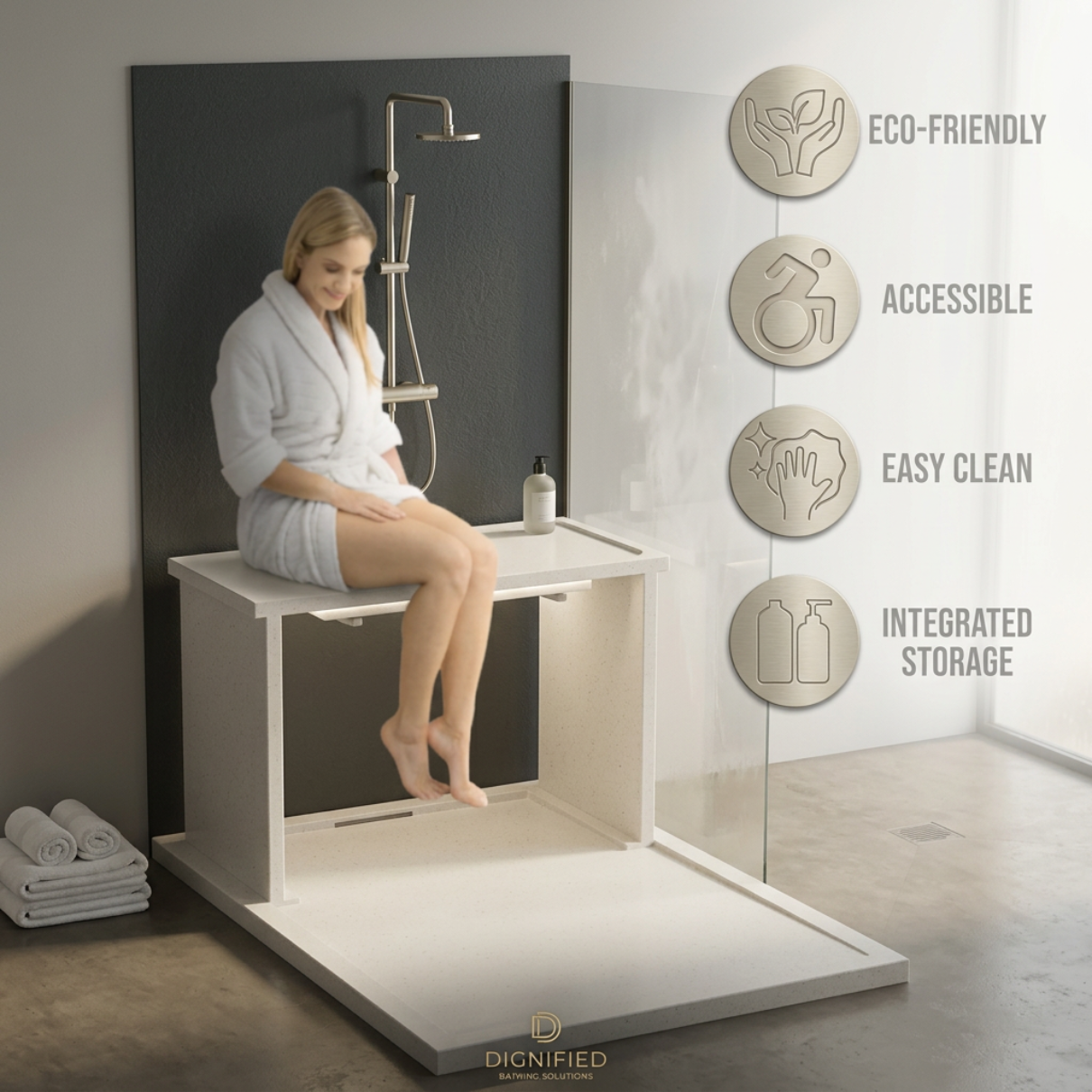
Dolmen asked the team to explore material choices for both high- and low-volume production of shower trays, analyse functional, aesthetic and experiential requirements across the product life-cycle, and apply those material innovations to a next-generation concept.
- Role
- Research, ethnography, ideation, concept development, materials selection, presentation board
- Duration
- 6 weeks
- Tools
- Field research & interviews, Competitor analysis, Materials research, CAD, Rendering, Presentation board layout
The brief
Material choices are a core part of the design process; responsible and efficient material choices have the potential to change the life-cycle impact of a product.
We were asked to explore the material choices for both high and low volume production of shower trays — analysing the functional, aesthetic and experiential requirements across the entire product life-cycle, identifying opportunities for innovative material selections, and applying them to new concepts for the next generation of shower trays. We were also asked to create a resource library to help Dolmen's design team capture and record tacit knowledge about the materials we encountered.
Research
We mapped journey maps for the average consumer and the fitter, ran competitor analysis across Artweger, Duravit, JT, Geberit and Kohler, and built personas spanning home-owners, landlords, elderly users with limited mobility and the installer.
Showering behaviours, cleaning frequency and water-cost data came from an Angie's List survey of approximately 2,000 individuals. In-store ethnography was carried out at Essential Bathrooms & Tiles, B&Q and PJ Matthews to talk through customer drivers with sales staff.
Future-trends research covered chromatherapy, music-integrated shower heads, sleek easy-clean systems and modern outdoor loop showers.
01
Design Avenue 1 — Eco-conscious home-owner
Young teacher renovating her first bathroom on a modest budget. Wants an eco-conscious alternative to acrylic without compromising on style — durable, easy to maintain, suitable for high-volume production.
02
Design Avenue 2 — Top-of-the-line spa user
Retiring couple fitting a 'spa-throom'. Largest budget for high-tech features, very low maintenance, anti-slip optional. Materials similar to stone resin, ideally carbon-neutral.
03
Design Avenue 3 — Elderly with limited mobility
Avoid the hospital-esque look. Provide security, mobility, comfort and dignity. Tray flush with floor, anti-slip surface, integrated accessories.
04
Design Avenue 4 — Landlord, quick & cheap
Quickest, cheapest fix that doesn't impact profits. Decision drivers in order: dimensions, cost, function. Style and material secondary.
05
Design Avenue 5 — Fitter / installer
Often works alone. Density and weight matter for transport and carrying upstairs. Easy disposal of wastes is a real pain point.
Final concept — Remove · Twist · Wash · Return
The final concept incorporates Universal Design principles and circular materials to deliver an accessible, easy-clean and sustainable alternative to the clinical, ecologically damaging products commonly seen on the market today.
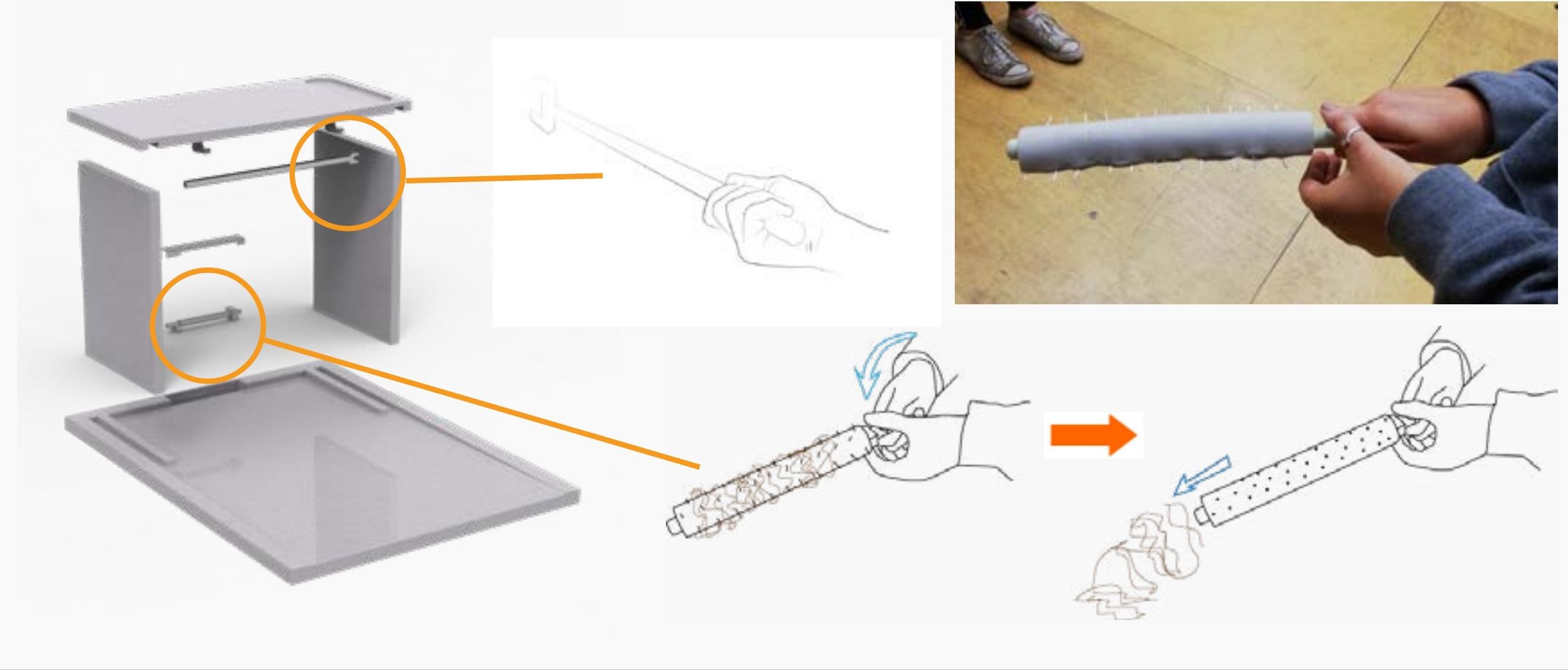
A no-contact hair catcher sits in the drain. The cleaning aid lifts the drain lid and removes the catcher without bending; twisting it pulls the prongs in so the hair falls off cleanly, and the catcher is returned ready for use.
Eco-friendly, accessible, easy-clean and integrated with storage for cleaning aids — twelve components in total, with stainless steel drain hardware and a Vetrostone™ tray and seat (with sustainable concrete as a substitute option).
Specifications
- Vetrostone™
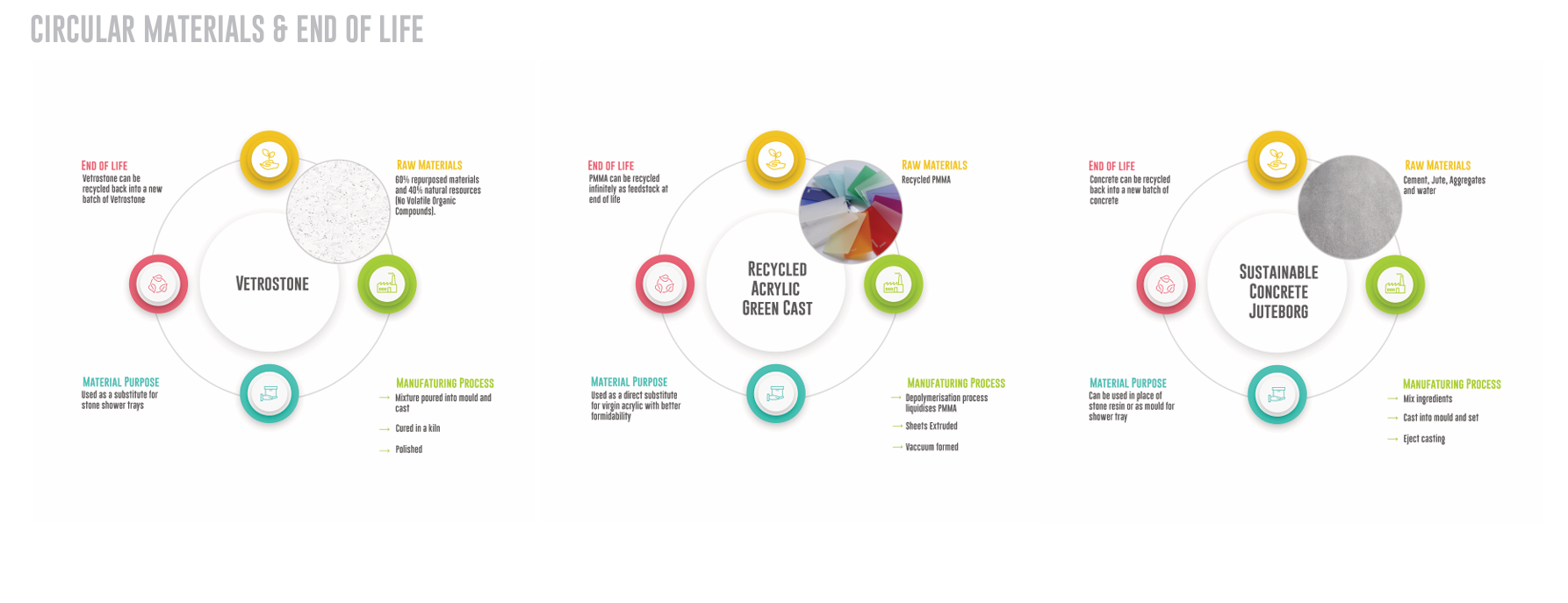
- 60% repurposed materials, 40% natural resources, no VOCs. Mixture cast in mould, kiln-cured, polished. Recyclable back into a new batch of Vetrostone.
- Recycled Acrylic Greencast
- Recycled PMMA depolymerised to liquid, sheet-extruded and vacuum-formed. Direct substitute for virgin acrylic, infinitely recyclable as feedstock.
- Sustainable Concrete (Juteborg)
- Cement, jute, aggregates and water. Cast and ejected from mould. Recyclable back into a new batch of concrete.
Team
Real-World Studio 2019 — University of Limerick × Dolmen Design + Innovation. Team: John Shanahan, Johnathan Wade, Jeffrey Smith, Megan O'Mahony.